
You're Betting the Toughest Market on the Board. Here's What to Do Instead.
Most bettors lose not because their analysis is wrong, but because they are betting the wrong markets. Player props offer an edge that spreads and totals cannot match.
Why Betting Spreads and Totals Is So Hard to Win
Most sports bettors start in the same place: spreads, totals, and the occasional moneyline. It makes sense. Those are the markets sportsbooks advertise, the ones TV broadcasts talk about, and the ones every betting app puts front and center.
They are also the most efficient markets on the board. That is the main reason most bettors lose.
If you have spent any time betting point spreads and game totals, you already know the feeling. You do the research, build a case, place your bet, and still end up on the wrong side more often than you expect. It is not necessarily because your analysis is bad. It is because you are competing in a market that is ruthlessly efficient. You are essentially paying the vig on coin-flip outcomes.
There is a better game available. Most bettors walk right past it on their way to the spread. It is less crowded, harder to price efficiently, and far more responsive to the kind of research an individual bettor can actually do.
That market is player props.
Why You Keep Losing on Spreads and Totals
Spreads and totals in leagues like the NBA, NFL, and MLB are among the most efficient betting markets in the world. They attract the most money, the most attention, and the most professional competition.
On a typical NBA night there are roughly 6 to 9 games. That is 6 to 9 spreads and 6 to 9 totals. A small number of lines. That means the sharpest money in the world is concentrated on the same limited set of numbers.
That matters for three reasons:
1. The number of main markets is small.
There are only so many main lines worth fighting over. Every sharp operation focuses on the same handful of games every night. You are not finding an edge they missed. You are arriving after they already cleared the table.
2. You are competing against the sharpest bettors in the world.
Professional betting groups deploy models, multiple traders, and dedicated analysts focused on the same handful of games. Inefficiencies get hit within minutes. Sometimes seconds. There is nowhere to hide in a market that small.
3. The limits are high. So is the competition.
Think of it this way. Sharp groups bet as much as the book will allow. When limits are high, the best groups show up with real money. That volume of sharp action forces the line into place fast. By the time you see the number, there is a good chance it has already been pushed to where it should be.
This is why betting spreads and totals as a solo bettor is one of the hardest games you can choose. You are stepping into the most competitive arena in the entire ecosystem, where edges are thin and the vig punishes every small mistake. You can still win. But you need to be consistently better than the sharpest money in the world. Most people are not. That is not an insult. It is just the math.
Why Player Props Are Easier to Beat Than Spreads and Totals
The props market operates by entirely different rules.
Those same NBA games do not just produce 10 to 20 main-market lines. They produce hundreds of individual player prop lines across points, rebounds, assists, threes, blocks, steals, combos, alternate lines, and more. Often over a thousand.
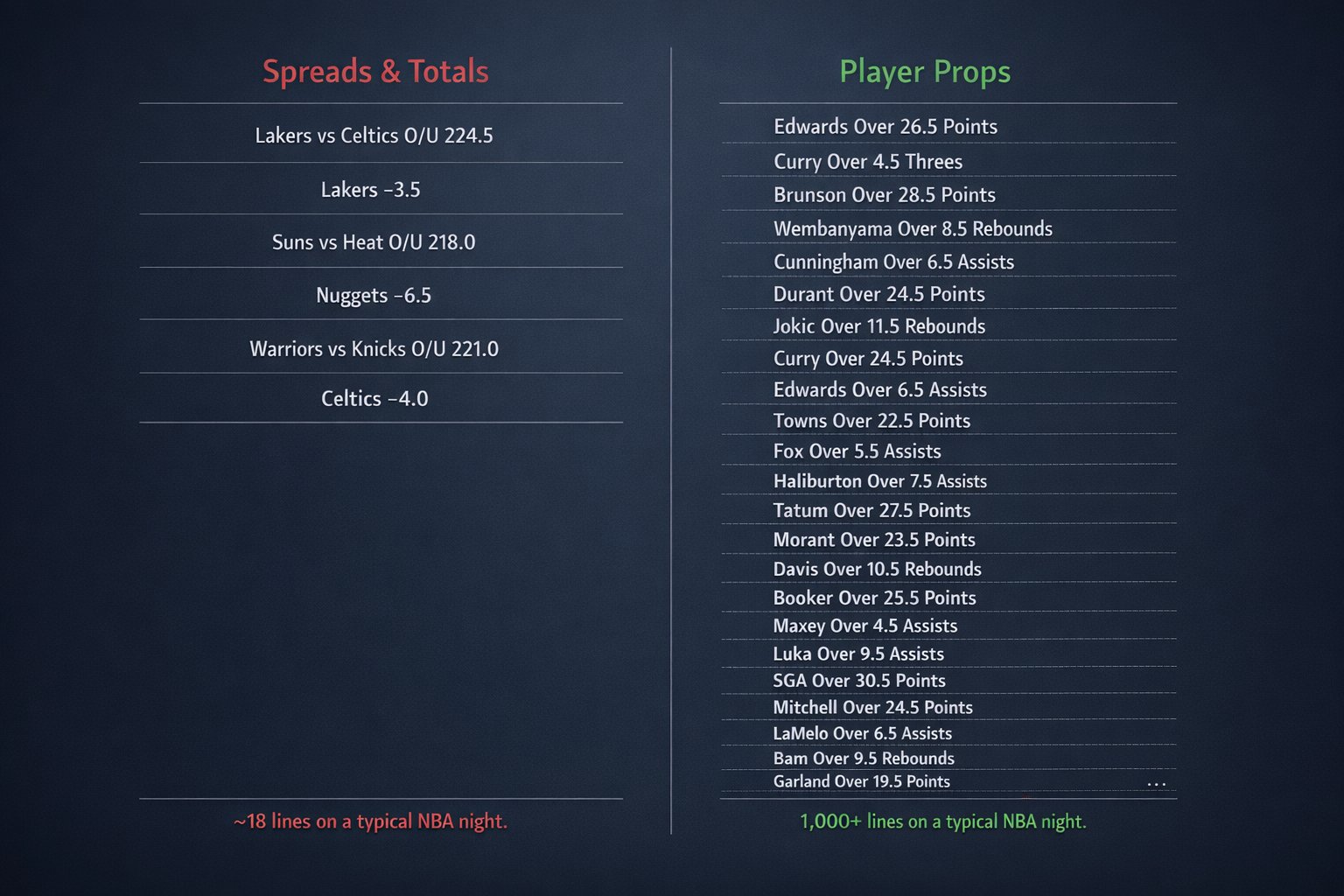
Player props vs spreads: ~18 main lines vs 1,000+ prop lines on a typical NBA night
This changes everything.
1. There are too many numbers to perfectly price.
Sportsbooks can allocate serious attention to sides and totals. They cannot allocate the same level of attention to every single player prop across every game, every night. Even with automation, pricing that many markets perfectly is hard. Mistakes happen regularly.
2. Limits are smaller, so big groups often prioritize elsewhere.
Many player prop markets carry lower limits than spreads and totals. That does not mean sharps ignore props entirely, but the biggest groups focus their capital on markets where they can bet bigger. Less competition means more opportunity for you.
3. Props are sensitive to information that does not always hit the market cleanly.
Minutes changes, role changes, matchup-specific usage, injury news, coaching patterns, and lineup combinations can all dramatically shift a player's expected output by 30–40% or more. A spread can absorb a lot of that into one number. Props often cannot, because each player is its own micro-market.
The result is a market with more moving parts, more prices to manage, and more chances for sportsbooks to be wrong. Volume creates opportunity.
What Is the Best Strategy for Betting Player Props?
Knowing props are the better market is only half the battle. Here is what actually separates winners from losers.
1. You are betting numbers, not players.
Your edge is not "this guy is good." Your edge is "this line is wrong." The same prop can be a great bet at one number and a terrible bet at another. Without the right price, even the sharpest read means nothing. This is the most important mindset shift in player prop betting.
2. Minutes and role matter more than narrative.
Casual bettors love storylines: revenge games, hot streaks, nationally televised matchups. Sharp bettors look at minutes projections, rotation patterns, and usage rates. A player's statistical output is overwhelmingly driven by how many minutes they play, what role they fill, and the matchup they are facing.
This is exactly the research problem PropsMadness was built to solve. It shows expected minutes projections for every player alongside their performance graph, so you can filter out games where a player's role was significantly different from what is projected tonight. That context alone changes how you read a line.
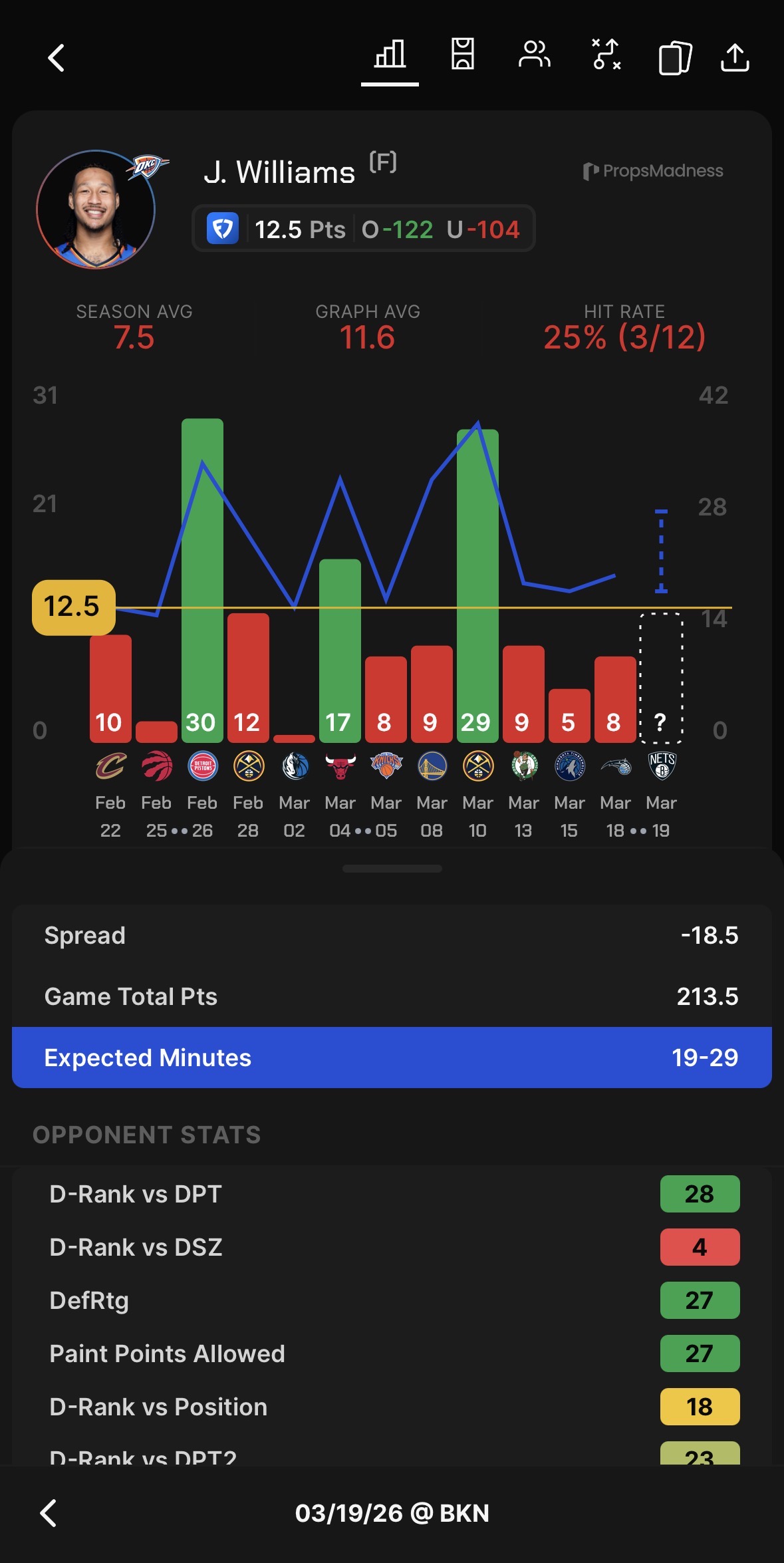
Expected minutes projection with minutes played per game
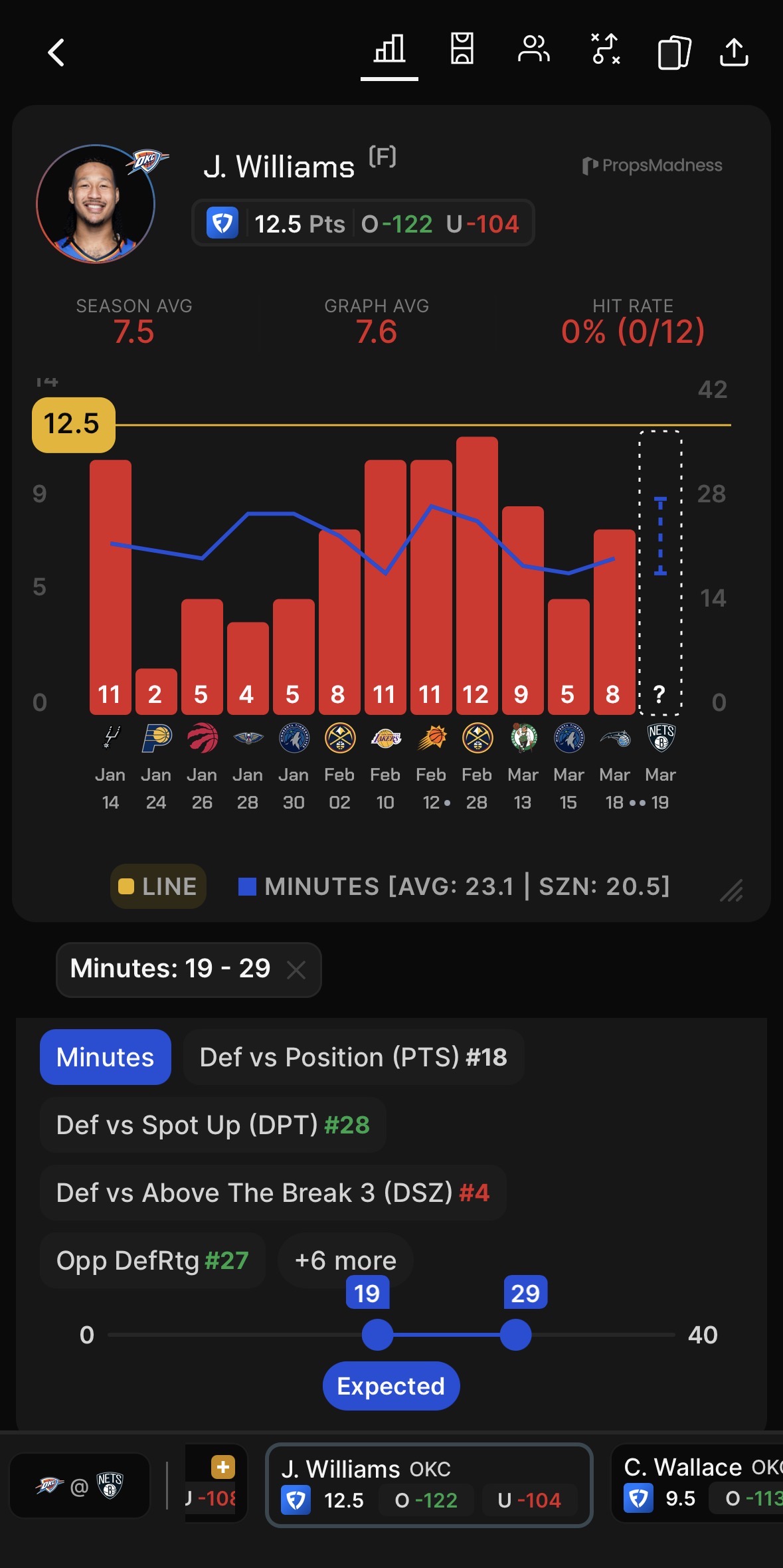
After filtering: outlier games removed, true performance picture emerges
3. Line shopping is a bigger edge than most bettors realize.
One app, one number, one bet. That is how most people operate. But the difference between 19.5 and 20.5 on a points prop, or between -105 and -120 on the same line, is the difference between a winning and losing season. Over 1,000 bets a year at flat $100 units, consistently getting the better number can make a $5,000+ difference. And that is before accounting for any difference in outcome. Getting the sharpest price on every bet you make is not optional. It is the easiest edge you can give yourself.
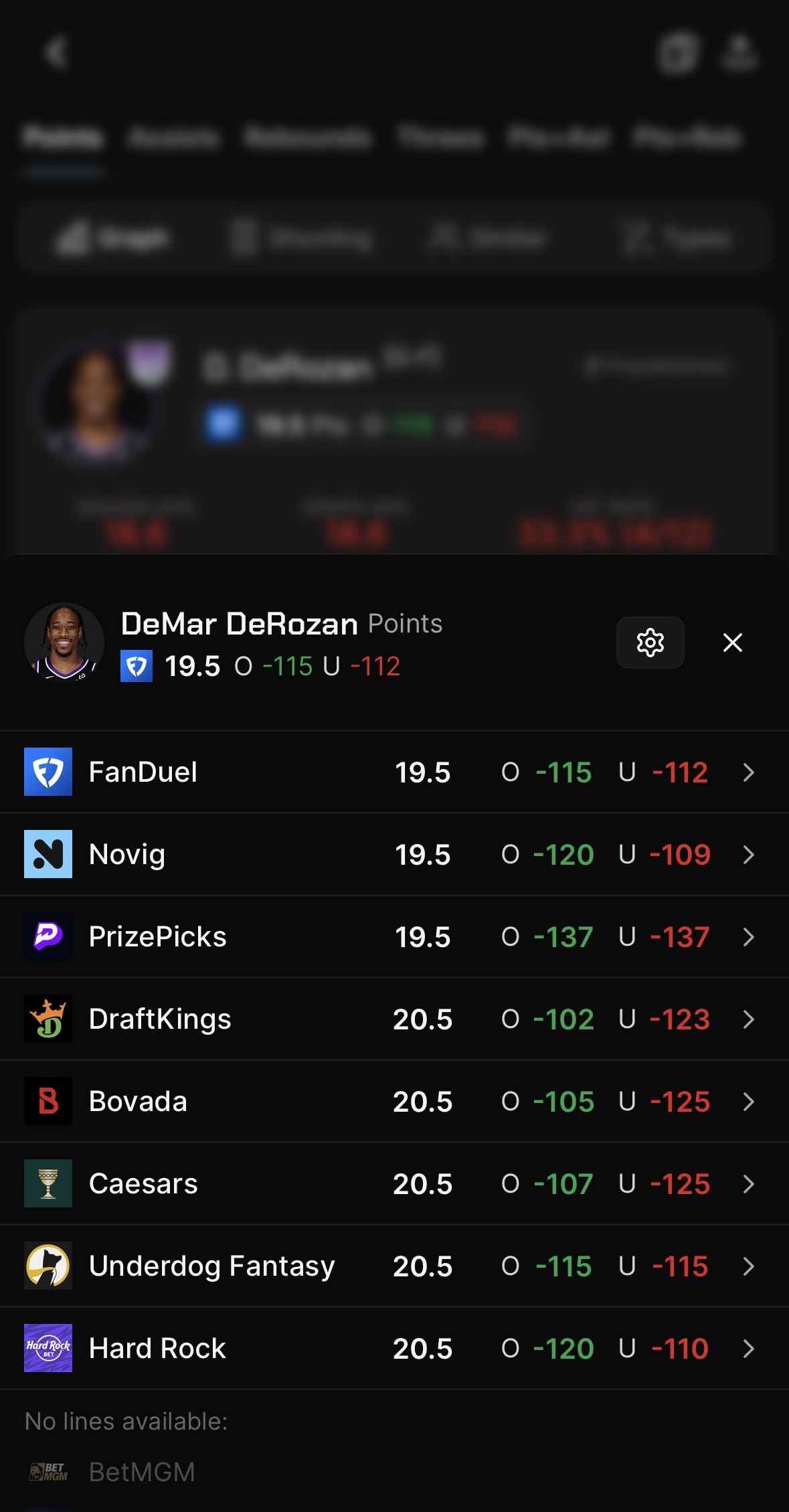
Line shopping player props: the same bet at different prices across books
4. Timing is part of the edge.
Props move fast when information hits: injury reports, starting lineups, rotation changes, market steam. Sometimes the edge is betting early before the market adjusts. Sometimes it is waiting for confirmation instead of guessing. Knowing when to act and when to hold is a skill. If you are consistently late, you are not unlucky. You are betting after the lines already moved and the edge is gone.
5. Track everything.
Props carry more variance than most bettors expect. A strong process can produce a losing week. A weak one can accidentally produce a winning month. The only way to know where you actually stand is to track your bets over a large enough sample to separate skill from randomness. Several hundred bets at minimum. Most bettors never get there because they stop tracking after a cold streak, or never start in the first place. If you are not tracking, you are guessing.
How PropsMadness Fits Into This
The research process described above (checking minutes, analyzing matchups, filtering by role and usage, comparing odds across books) used to require jumping between four or five tools. PropsMadness puts all of it in one place:
- Know whether tonight's minutes support the line: expected minutes projections for every player, before you bet it
- Filter by matchup, shot zone, and teammate impact: 50+ filters, all updating the graph and averages instantly
- Never miss a key rotation change: injury and lineup context built directly into the player view
- Shop 40+ sportsbooks in seconds: live odds side by side without opening a single extra tab
- See how often a player has hit the line: hit rates and historical trends under the exact conditions you filtered for
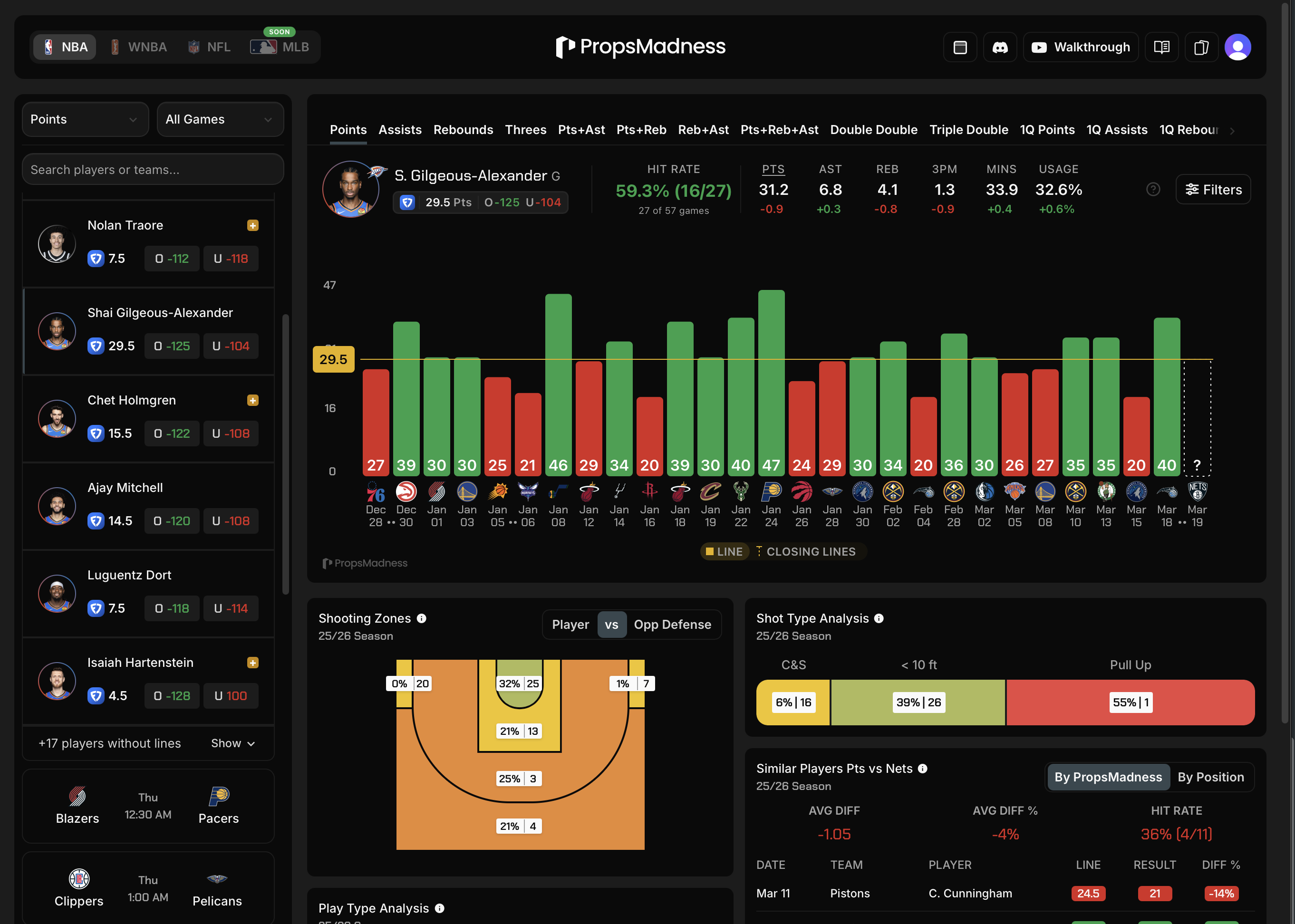
Player prop research in one view: graph, filters, odds, and advanced analytics
Start free. No account needed. Research your first prop in under five minutes.
The Bottom Line
Player props are not easy. Nothing in sports betting is. But they offer something spreads and totals do not: a market where volume creates daily inefficiencies that a focused bettor can genuinely exploit. You are not going to outmodel a professional betting group on an NBA spread. But in the props market, you do not have to. It is large enough, inefficient enough, and mispriced often enough that a solo bettor with the right process can build a real edge over time.
Nothing about this gets easier with time. The spread market is not going to become less efficient. But the props market is not going to stay this inefficient forever either. The best time to start was yesterday. The second best time is tonight's slate.
Frequently Asked Questions
Are player props actually beatable long term?
Yes. The props market is less efficient than spreads and totals because sportsbooks have to price thousands of lines every night, and they cannot give each one the same level of attention. That creates daily pricing errors a focused bettor can exploit. You still need sharp research, proper line shopping, and smart bankroll management. But unlike spreads, the opportunity is actually there. Tracking your bets over a large sample is the only way to confirm your edge is real and not short-term variance. At least several hundred bets.
What is the most important factor in player prop research?
Minutes and matchups. How many minutes a player gets and who they are playing against drives everything. A starter averaging 32 minutes per game will produce very different numbers than a rotation player getting 18. Expected minutes projections, injury reports, and teammate availability should be the first thing you check before analyzing any prop line.
How many sportsbooks do I need to shop lines effectively?
Ideally at least four to six accounts across major books. The more books you have access to, the more often you will find the best price on any given prop. Even getting 19.5 instead of 20.5, or -105 instead of -120, adds up fast over hundreds of bets. PropsMadness compares live odds from 40+ books in a single view, so you can identify the best available price in seconds without opening multiple apps.
How do I know if I actually have an edge or just got lucky?
Sample size. A hot week can feel like an edge, and a cold stretch can feel like bad luck. You need at least a few hundred tracked bets to know which one it actually is. Track the market, line, odds, result, and closing line value for every bet. If your lines consistently move in your favor after you bet them, that is one of the strongest signals you have an edge.
Do I need a paid tool to bet props successfully?
No. But the right tools dramatically reduce the time it takes to do proper research and significantly improve your ability to spot mispriced lines quickly. Without tools, you are manually checking stats, injuries, minutes, and odds across multiple sites, a process that can easily consume 20 to 30 minutes per player for any meaningful level of analysis. PropsMadness has a free tier that lets you analyze multiple players per day with no account required. The premium tier unlocks unlimited players, 40+ sportsbooks, and the full filter suite for $25/mo with a 7-day refund guarantee.